
Police stations form the operational backbone of public safety in communities worldwide. From processing crime reports to coordinating emergency response, these facilities handle complex, time-sensitive operations around the clock.
Digital signage is widely used in public spaces for information dissemination and communication, making it a natural fit for police stations seeking to improve internal and external messaging.
Modern police stations increasingly rely on real-time information systems to keep officers informed and responses coordinated. On-premise screens and digital signage have become valuable tools for displaying duty rosters, alerts, and critical updates without depending on external networks. This article explores how police stations function, what facilities they contain, and how solutions like SignageTube Live support internal communication and emergency alerting inside these mission-critical environments.
Introduction to Police Stations
A police station serves as a local base for law enforcement operations, handling everything from crime reporting and initial investigations to temporary detention and community services. These facilities provide immediate access to public safety resources, with studies indicating that proximity to a station can reduce emergency response times by 20-30% in urban areas. Police stations manage crime data, evidence storage, and jail facilities for short-term detention.
The first modern police stations emerged in the 19th century. London’s Metropolitan Police Service traces back to 1829 under Sir Robert Peel, establishing station-like posts across the city. In the United States, the NYPD operates 76 precincts, with the first established in 1845 as part of the Municipal Police Force. Reporting and records services at police stations include filing police reports, obtaining copies of accident reports, and criminal records.
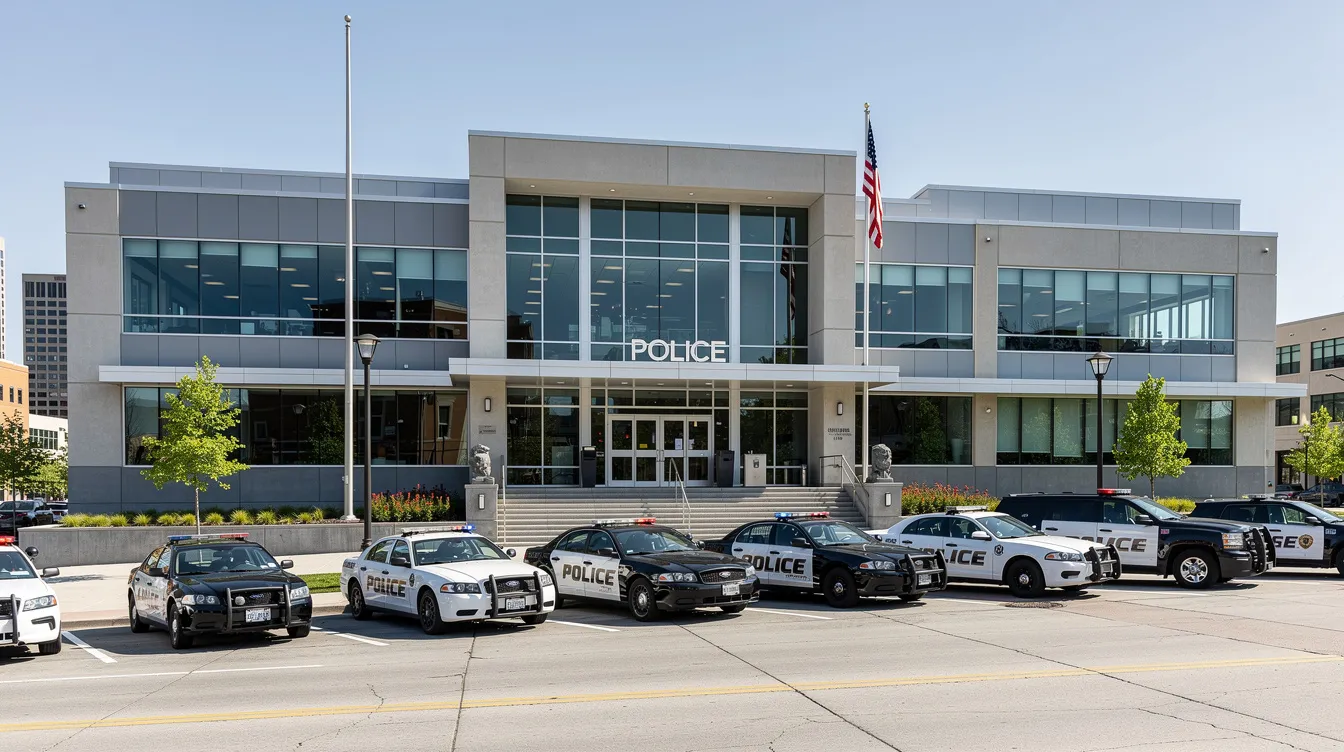
Police stations provide diverse services, including filing reports, obtaining background checks, and community outreach. They offer specialized units for investigations, victim advocacy, and crime prevention. Safety programs, such as child seat safety checks and neighborhood watch programs, are commonly available. Many police stations offer fingerprinting and background checks for employment or licensing needs. Victim advocacy resources are available for victims of domestic violence, sexual assault, or elder abuse at police stations. Police stations also conduct welfare and safety checks on elderly or vulnerable residents, like ‘You Are Not Alone’ programs. Educational workshops on identity theft, workplace safety, and home security surveys are often provided. Police stations deliver non-emergency services that residents can access directly. Increasingly, police stations collaborate with mental health professionals and social services to provide crisis intervention.
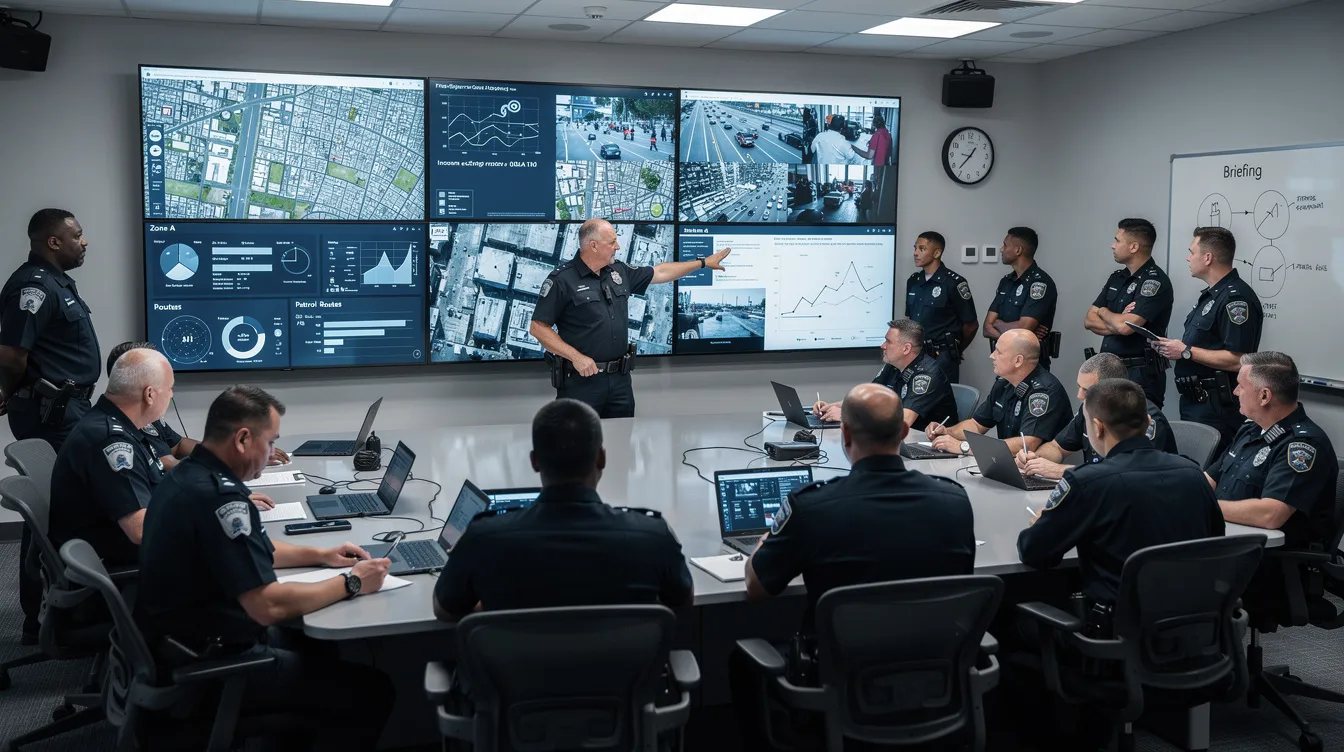
Today’s stations have evolved beyond paper-based systems. Digital dashboards display real-time crime mapping, officer deployment data, and be-on-the-lookout alerts in briefing rooms. This integration of technology helps stations deliver important emergency information faster while maintaining operational efficiency. Modern policing focuses on transparency and collaboration through community policing. Police stations engage in community policing by hosting events like ‘Coffee with a Cop’ or National Night Out. Police collaborate with schools, faith-based organizations, and businesses to proactively identify and solve neighborhood problems. Operations, investigations, and administration & support are typically the three primary divisions in police departments. Most police departments follow a paramilitary structure with a clear chain of command to ensure efficient decision-making. Many police stations are incorporating technology, such as online reporting systems and advanced surveillance systems. Companies across industries are implementing innovative solutions like predictive analytics and digital signage to optimize operations and reduce environmental impact, supporting the modernization of police station practices and demonstrating how PowerPoint-based digital signage for organizations can scale efficiently across multiple locations.
Core Functions of a Police Station
Police stations handle four primary operational areas that keep communities safe and maintain order.
Law enforcement encompasses receiving crime reports via walk-ins, phone calls (911 in the US, 999 in the UK), or online portals. Officers issue incident numbers essential for insurance claims and court proceedings. In the UK, under the Police and Criminal Evidence Act 1984, stations must provide reference numbers within 24 hours.
Initial investigations involve taking statements, collecting evidence, and logging materials in secure chain-of-custody storage. Evidence rooms feature tamper-proof lockers and climate-controlled conditions to preserve forensics like DNA samples. Determining the root causes of incidents through diagnostic analysis is a key part of these investigations, helping officers uncover underlying factors that inform further action.
Temporary detention operates within strict legal frameworks:
- United States: 24-48 hours under Miranda rights and local statutes
- United Kingdom: Up to 96 hours extendable under PACE with magistrate approval
- Australia: 8-12 hours initially under the Police Powers and Responsibilities Act 2000
Community service and administration includes lost property handling, background checks, patrol coordination, and management of special units like domestic violence teams or cybercrime divisions.
Emergency response coordination relies on internal noticeboards and on-premise digital signage to display duty rosters, BOLOs, and high-priority alerts. Effective internal communication reduces dispatch errors by 15-25% according to law enforcement technology reports.
Data-driven decision-making can help police stations improve operations and community engagement.
Layout and Facilities Inside a Typical Police Station
Walking through a typical station reveals a progression from public-facing areas to highly secured zones, each designed for specific operational needs.
Public-Facing Areas
- Reception desk with bulletproof glass, panic buttons, and accessibility features (ramps, hearing loops)
- Waiting area with secure seating
- Interview rooms with one-way mirrors and soundproofing for victim and witness privacy
Secured Operational Spaces
- Briefing room with projector screens or digital walls for maps and alerts
- Incident rooms with whiteboards and CAD terminals for case mapping
- Locker rooms for personal gear storage
- Armory with biometric access for weapons and ammunition
- Evidence rooms with RFID tracking systems
- Communications center managing radio frequencies and 911 integration
Processing Areas
- Booking desk for biometric scanning
- Identification parade rooms with controlled lighting
- Breathalyzer and drug testing suites
- Secure sally port for prisoner transport vehicles
Modern Additions
Modern additions include CCTV control rooms monitoring 50-200 cameras with AI analytics, server rooms hosting records management systems, and video walls aggregating live feeds from body cams and drones. Digital signage can also incorporate audience analytics and IoT sensors for enhanced engagement and personalization.
On-prem digital signage screens can be mounted throughout the station, and regular maintenance is essential for operational efficiency and device longevity, ensuring consistent performance and visibility.
|
Location |
Typical Content |
|---|---|
|
Reception |
Public safety messages, wait times |
|
Staff corridors |
Shift rosters, policy updates |
|
Briefing rooms |
Live incident maps, BOLOs |
|
Custody suites |
Detainee rights information |
|
Digital signage allows for dynamic and real-time content updates, often controlled remotely through content management systems. |
|
Introduction to Digital Signage
Digital signage is transforming the way organizations communicate, offering a dynamic platform for delivering information, advertising, and alerts in both public and private spaces. For police stations and other public safety organizations, on-prem-based digital signage for police departments has become a crucial tool for sharing timely and relevant updates. Leveraging advanced technology, these systems enable the efficient management and display of real-time content, ensuring that important messages reach their intended audience without delay.
In emergency situations, digital signage plays a vital role by integrating with the emergency alert system and NOAA weather radio. On-prem-based digital signage emergency alert systems allow police stations to deliver important emergency information—such as severe weather warnings or evacuation notices—directly to staff and visitors. The ability to manage and update content instantly makes digital signage an essential component of modern emergency response infrastructure, supporting both routine operations and critical incident management. As technology continues to evolve, digital signage remains at the forefront of efficient, timely, and crucial communication for organizations dedicated to public safety.
Digital Signage Technology in Law Enforcement
Law enforcement agencies are increasingly adopting digital signage technology to enhance public safety and streamline communication. By integrating with the Emergency Alert System (EAS) and the National Weather Service, police stations can deliver important emergency information—such as amber alerts, severe weather updates, and national emergency notifications—directly to officers and the public in real time. These digital displays are strategically placed in police stations, public areas, and even mobile units to ensure that critical alerts and real-time content are always accessible.
Beyond emergency notifications, digital signage empowers law enforcement to engage with the community through educational campaigns, crime prevention tips, and public awareness messages. The technology’s ability to inform and alert the public quickly and efficiently makes it a valuable asset for any agency focused on public safety. By leveraging digital signage, police departments can improve their responsiveness, keep communities informed, and deliver crucial information when it matters most.
Hardware Components
The effectiveness of digital signage in law enforcement relies on robust hardware components designed for reliability and real-time performance. Displays range from compact screens in reception areas to expansive video walls in command centers, ensuring that important information is visible wherever it’s needed. Media players are responsible for processing and delivering content to these screens, often supporting real-time updates and seamless playback. Mounting equipment secures displays in high-traffic or sensitive locations, maintaining both safety and visibility.
In addition to these core elements, digital signage systems may incorporate sensors and smart devices that detect environmental factors such as motion, light, or sound. These features enable the system to respond dynamically—for example, activating specific alerts when someone enters a restricted area or adjusting screen brightness based on ambient light. Together, these hardware components create a responsive, reliable network of screens that support law enforcement’s mission to deliver timely and relevant information.
Software Components
Behind every effective digital signage deployment is a suite of powerful software components. Content management software allows users to create, schedule, and manage digital signage content remotely, ensuring that the right messages are displayed at the right time and location. This centralized approach streamlines operations and reduces the risk of outdated or incorrect information being shown.
Operating systems—such as Windows, Android, or Linux—run on the media players and displays, providing a stable foundation for the signage network. Playback software is responsible for rendering content, supporting a variety of formats including video, images, and audio. These software systems work together to give users full control over their digital signage, making it easy to update content, manage multiple screens, and ensure that important emergency information is always delivered efficiently and reliably.
Police Stations and Emergency Alerts
The Emergency Alert System (EAS) is a national public warning system used by state and local authorities to deliver important emergency information. The Federal Emergency Management Agency (FEMA) is responsible for national-level activation, tests, and exercises of the EAS. The EAS allows the president to address the nation within 10 minutes during a national emergency.
Police stations function as integral nodes in emergency alert ecosystems, receiving feeds from systems like the US Emergency Alert System (EAS) and Integrated Public Alert & Warning System (IPAWS), which disseminated over 1,500 alerts in 2024 including AMBER alerts and weather warnings. Authorities send alerts through various channels, including digital billboards, NOAA radios, and mobile devices, to ensure rapid and widespread dissemination of critical information. Wireless Emergency Alerts (WEAs) are short emergency alerts sent to WEA-enabled mobile devices in targeted areas.
The national public warning system connects stations to central command, 911 call centers, and agencies like the National Weather Service. Information flows from emergency operations centers to regional command, then to local stations, and finally to patrol units and community notifications. Protocols ensure relay times under one minute.
A real-world example: During Hurricane Helene in September 2024, coastal stations in Florida’s Pinellas County received NWS flood warnings via IPAWS at 1400 UTC. They activated EOC protocols to update patrol routes, close over 200 roads, and notify 50,000 residents via SMS and sirens while coordinating shelters for 10,000 evacuees.
Real-time internal communication proves crucial for dynamic updates:
- Evacuation routes and road closures
- Missing person information
- Shelter locations and capacity
- Officer deployment changes
On-prem digital signage inside stations can mirror national alert systems with station-specific instructions, ensuring officers receive both regional and local context for their response. NOAA weather radio feeds and EAS alerts can be integrated directly into station displays, helping inform personnel about developing situations.
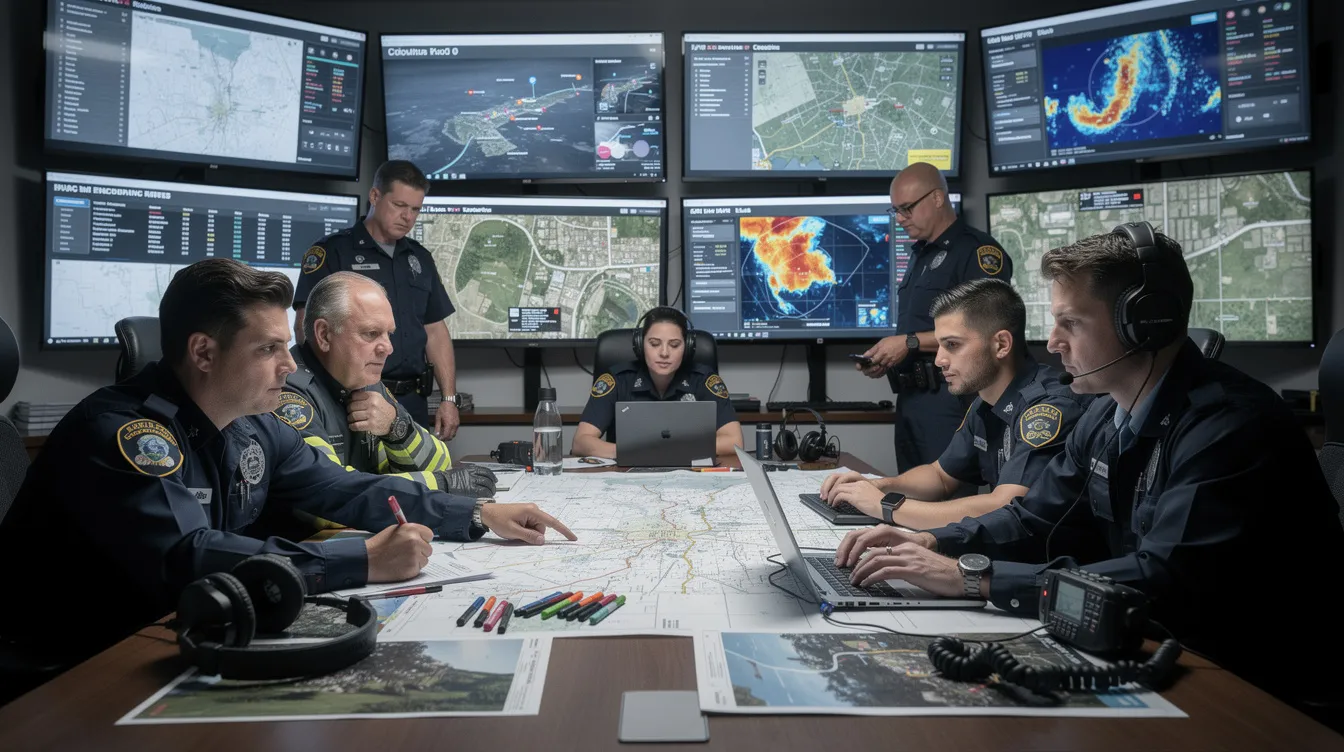
Real-Time Digital Signage in Police Stations
Real-time on-prem digital signage refers to screens driven by local players that update instantly without relying solely on the public internet. These systems connect to internal data sources and networks, enabling real-time updates and seamless integration with mission-critical applications. This technology runs on existing infrastructure within the station’s network, ensuring 99.9% uptime in mission-critical settings.
Practical use cases include:
- Live incident dashboards pulling data from CAD systems (300-500 daily calls in urban precincts)
- Automated weather and hazard feeds from NOAA APIs
- Suspect photos and BOLOs updating every 30 seconds
- Shift rosters synced to HR systems
- Training clips during downtime
- Internal policy updates and compliance reminders
Techniques such as audience measurement, data integration, and real-time analytics can be employed to optimize content delivery and ensure relevant information reaches the right personnel at the right time, especially when using SignageTube Live real-time digital signage to drive those on-premise screens.
Government and public services often need real time content triggered by local events—an alarm activation, dispatch status change, or access control alert—with minimal delay. Integration with existing systems like CAD, dispatch, and CCTV can streamline response coordination and officer safety. Monitoring market trends and demand forecasting can further inform resource allocation and operational planning.
On-premise setups maintain operation during WAN outages. This matters because approximately 20% of US public safety outages stem from internet failures according to NIST data. When external connectivity fails during a national emergency, local systems continue functioning.
Data-driven decision-making (DDDM) emphasizes using data and analysis instead of intuition to inform decisions. Organizations that adopt a data-driven culture see benefits such as improved customer satisfaction and better strategic planning. Data-driven decision-making allows organizations to generate real-time insights and predictions, optimizing performance and testing new strategies. Data provides a solid foundation for making decisions, reducing uncertainty and increasing confidence. Data-driven decisions minimize personal bias and safeguard objectivity. Predictive analytics allow organizations to anticipate trends or challenges and take preemptive actions. However, implementing data-driven decision-making can face challenges such as neglecting data quality and data illiteracy.
Community engagement can also be enhanced by leveraging digital signage to improve customer engagement and better understand the needs of community members, ultimately serving customers more effectively through data analytics.
Compared to cloud-dependent platforms, on-prem solutions offer:
- Continued operation during connectivity crises
- Data sovereignty for CJIS compliance
- Integration latency under 5 seconds
- Lower long-term costs using existing hardware
It is important to note that digital signage can contribute to environmental concerns such as electronic waste and light pollution, which organizations should consider when planning deployments.
Digital Signage Content for Police Stations
Types of Content Displayed
The content displayed on digital signage in police stations is tailored to meet the unique needs of law enforcement and the communities they serve. Emergency alerts, such as amber alerts and severe weather warnings, are delivered in real time to keep both officers and the public informed of urgent situations. Public safety messages, including crime prevention tips and updates on ongoing investigations, help foster a safer environment and build trust within the community.
Police departments can also use digital signage to share community news, promote local events, and provide valuable data-driven insights into neighborhood trends and concerns. By analyzing the effectiveness of different messages and tracking engagement, agencies gain a deeper understanding of what matters most to their constituents. This ability to deliver timely, relevant, and valuable information not only enhances public safety but also strengthens the relationship between law enforcement and the communities they protect. Digital signage empowers police stations to inform, engage, and respond to the needs of their district with agility and precision.
SignageTube Live for Government and Public Services
This section addresses how SignageTube Live serves the Government and Public Services sector, specifically police stations, fire departments, and municipal buildings requiring secure, reliable digital signage.
SignageTube Live is SignageTube’s real-time, on-prem digital signage solution designed to run securely inside government networks. It operates without external dependencies, aligning with CJIS security standards that often require air-gapped or VLAN-isolated systems. Digital signage can enhance community engagement by providing real-time information to the public in police stations, keeping both staff and visitors informed about emergencies, safety tips, and local events.
Deployment timeline and effort:
|
Station Size |
Screens |
Typical Setup Time |
|---|---|---|
|
Small |
5-10 |
A few hours |
|
Mid-sized |
20 |
Under 4 hours to first live dashboard |
|
Large |
50+ |
1-2 days |
|
Installation involves placing player software on existing Windows or Android devices, connecting them to internal screens via HDMI, and building playlists using PowerPoint for digital signage. |
|
|
Practical tips for police station deployments:
- Design clear visual zones in PowerPoint layouts—alerts at top (red), maps and rosters in middle, weather at bottom
- Set priority rules so critical messages (BOLOs) automatically override routine content
- Schedule routine content outside peak emergency times (e.g., 0200-0600)
- Test failover procedures weekly to verify local caching during network issues
For detailed instructions on how to receive emergency warnings and alerts, refer to our dedicated page that outlines the available alert systems and notification options.
Disadvantages of alternative approaches:
|
Option |
Limitation |
|---|---|
|
USB sticks |
Manual updates required; no real-time capability |
|
Consumer streaming devices |
No central control; lack proof-of-play logs; high failure rate in government tests |
|
Pure cloud platforms |
Depend on external connectivity; outages can disrupt service for millions, including PSAPs |
Why PowerPoint and SignageTube Live work well together: PowerPoint digital signage guides show how existing slide design skills can be adapted for always-on screens in environments like police stations.
Organizations benefit because 90% of officers and administrative staff already know PowerPoint. Content creation becomes straightforward—drag and drop suspect photos, update shift schedules, or modify alert templates without specialized training. Reusable precinct templates reduce design time by approximately 70%, and updates push instantly to multiple screens from a central console, especially when following PowerPoint digital signage best practices.
Key features relevant to police and public services: Advanced capabilities like automated PowerPoint formatting in SignageTube Live also help keep complex dashboards and alerts readable as data changes.
- Live monitoring of all screens across stations
- On-prem hosting for compliance and data control
- User and site management for multiple locations
- Proof-of-play logs supporting audit trails in 24/7 operations
For police stations seeking reliable internal communication that maintains operation during crises, on-prem digital signage delivers both security and operational efficiency. Broader digital signage blog resources on PowerPoint and SignageTube can also help agencies refine their content strategy. Explore how SignageTube Live can support your station’s mission-critical operations with timely, relevant information on every screen.