
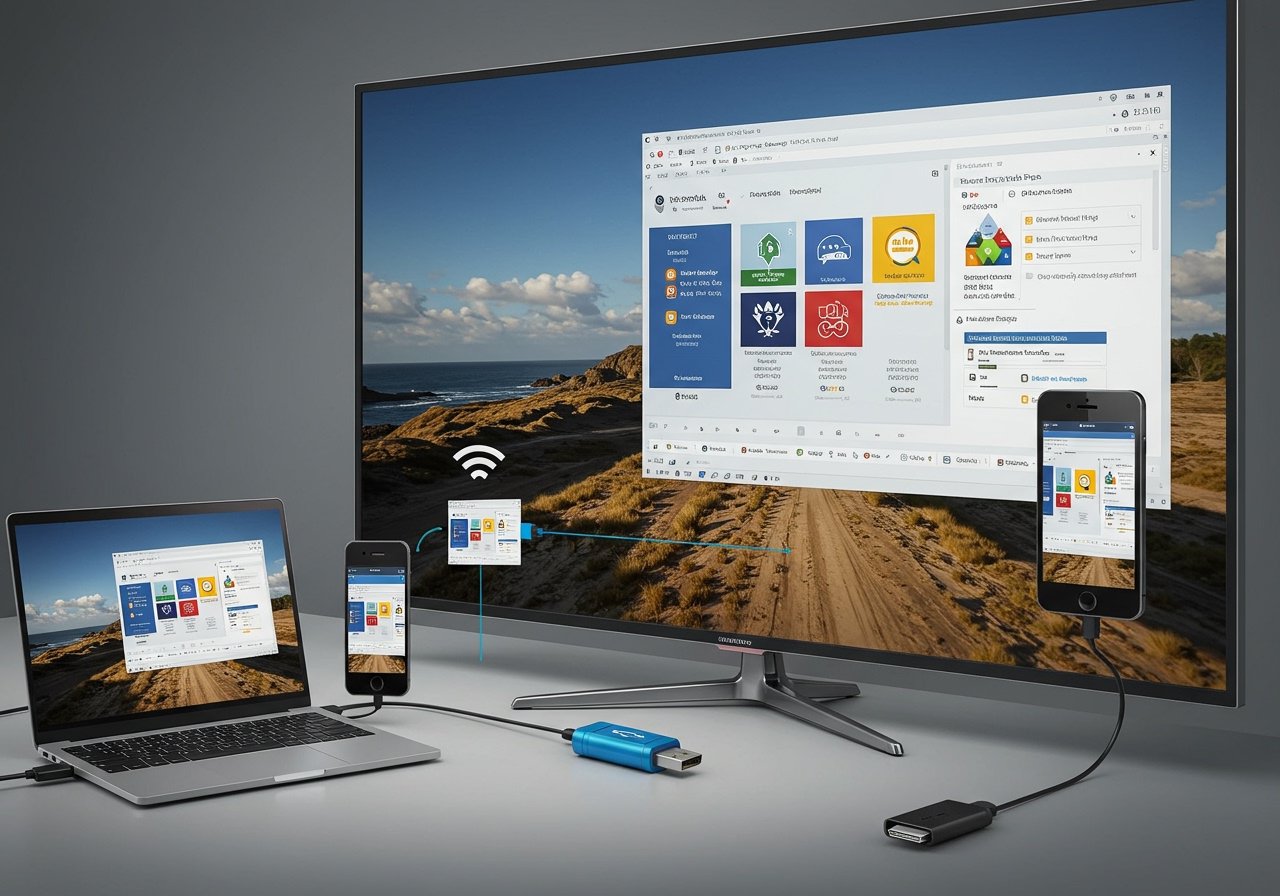
Learn how to play PowerPoint presentations on any TV. Discover simple methods and tools to display slides, loop content, and turn your PowerPoint files into professional digital signage for offices, retail, events, and more.
Showing a PowerPoint on a TV is one of the fastest ways to make your message feel bigger, clearer, and more shared—whether you’re presenting live, running a loop in a lobby, or broadcasting information across multiple locations. Displaying PowerPoint on a TV helps engage your audience by making your content more visible and impactful.
This guide walks through the four most common ways to play PowerPoint on a TV:
- HDMI (most reliable)
- Wireless screen mirroring (most convenient)
- USB playback (no computer required—when supported)
- Digital signage software (best for multi-screen and continuous playback)
These methods allow you to display PowerPoint presentations from a range of devices, including laptops, Android and other mobile devices, for maximum flexibility.
You can also cast your presentation from Android and other mobile devices for a seamless experience.
You’ll also get a quick troubleshooting checklist and the “TV-ready” settings that prevent black bars, cropped edges, and audio surprises.
If you’re building a broader screen strategy (not just a one-off presentation), start with what digital signage is to understand the bigger picture.
What is digital signage?
Digital signage refers to using screens, such as TVs, to display multimedia content—including PowerPoint presentations—often managed remotely and scheduled for specific times. Digital signage solutions can enhance the visibility of presentations by displaying them on larger screens and providing centralized control over what is shown and when.
Converting your PowerPoint to compatible formats like MP4 or JPEG ensures smooth playback on various devices and smart TVs.
Quick checklist: What you need
Before you choose a method, users should confirm what devices and ports are available in the room.
- A TV with an available HDMI port (check your TV’s HDMI port for compatibility)
- Your PowerPoint file (.pptx)
- A laptop (Windows or Mac), Android phone/tablet, or other mobile devices (including iOS) (optional, with the right adapters)
- Optional items depending on method:
- HDMI cable
- Adapter (USB‑C to HDMI, Lightning to HDMI, etc.)
- Apple TV or AirPlay-compatible TV (for Apple wireless)
- A wireless display receiver (for Windows wireless)
- USB drive (for USB playback)
Method 1: HDMI cable (most reliable)
If you need a stress-free setup with minimal lag, HDMI wins
Using an HDMI cable is the most straightforward way to play PowerPoint on your TV. A TV can function as a large monitor for your presentation, providing a clear and professional display.
- Connect your laptop to the TV’s HDMI port using a standard HDMI cable.
- Use your TV remote to access the menu and select the correct HDMI input source.
- Your TV will now act as a monitor, mirroring your laptop screen.
- Open your PowerPoint presentation and start your slideshow.
For example, you might connect your laptop to the TV’s HDMI port and use the TV’s menu to select the input, turning your TV into a large monitor for your presentation.
Step-by-step (Windows and Mac)
- Connect your laptop to the TV using HDMI (use an adapter if your laptop only has USB‑C).
- On the TV, switch to the correct HDMI input.
- Set your laptop’s display mode:
- Windows: Duplicate/Mirror (or Extend if you want notes on your laptop)
- Mac: Mirror Displays (or use the TV as a second display)
- Open PowerPoint → start Slide Show.
Pro tips for a clean “TV look”
- Set your slides to Widescreen (16:9) so they match most TVs.
- If the slide edges look cut off, your TV may be using overscan. Look for TV settings like Just Scan, 1:1, Fit to Screen, or Screen Fit.
- If audio matters (videos, sound effects), do a quick test run—some setups keep audio on the laptop by default.
Best use cases
- Live presentations
- Training sessions
- Any scenario where stability matters more than mobility
Method 2: Use Presenter View on your laptop while the TV shows full-screen slides
This is the “professional presenter” setup: your TV acts as a second monitor, showing only the slides, while your laptop monitor displays notes, next slide, and controls.
Microsoft provides a step-by-step setup for presenting on multiple monitors with Presenter View. Present on multiple monitors (and view speaker notes privately)
Quick setup
- Connect the TV as a second display (HDMI).
- In PowerPoint: Slide Show tab → enable Presenter View.
- Put the slideshow on the TV display.
This is a great method if you want to look confident and stay on pace, especially when combined with real-time digital signage control for keeping content up to date.
Method 3: Wireless screen mirroring (AirPlay and wireless display)
Wireless is convenient when you can’t run a cable, but it depends on Wi‑Fi strength and can introduce slight lag.
You can cast your PowerPoint presentation wirelessly from Android and other mobile devices to smart TVs, making it easy for users to display presentations on a large screen. Smart TVs often support casting directly from mobile devices, allowing seamless sharing of your slides. One common question users have is how to cast a PowerPoint presentation from their device to a TV; the answer is to use built-in casting features or compatible apps.
Option A: AirPlay (Mac/iPhone/iPad → Apple TV or AirPlay TV)
Apple’s official guidance covers both screen mirroring and streaming via AirPlay. Start here:
- Use AirPlay to stream video or mirror the screen of your iPhone or iPad
- Stream content on a larger screen with AirPlay (Mac guide)
Typical flow:
- Make sure your Apple device and Apple TV (or AirPlay-enabled TV) are on the same Wi‑Fi.
- Turn on Screen Mirroring.
- Start your PowerPoint slideshow.
If it doesn’t connect or drops frequently, Apple’s troubleshooting checklist is practical: If screen mirroring or streaming isn’t working
Option B: Windows wireless display (Miracast / “connect to a wireless display”)
Many Windows laptops can connect to a wireless display receiver or compatible TV.
Typical flow:
- Connect the wireless display receiver to the TV.
- On Windows, connect to the wireless display.
- Start the slideshow.
When wireless is a good idea
- Informal presentations
- Rooms where cable routing is difficult
- When you need to move around while presenting
When wireless is risky
- High-stakes presentations (lag can distract)
- Unstable Wi‑Fi environments
Method 4: Play PowerPoint on TV with a USB drive (no computer)
This method can be great—when it works—but it’s also the most inconsistent, because TVs vary a lot in what file types they support. To improve compatibility, consider converting your PowerPoint (PPT) presentation to a compatible video format such as MP4 or WMV, or even to a PDF file. You can save your presentation as a video file (MP4 or WMV) or PDF for playback on most Smart TVs via USB. If your TV does not support PowerPoint files directly, converting your slides to a video format or PDF ensures your content displays correctly.
Important: Most Smart TVs do not support direct playback of PowerPoint files (.ppt or .pptx) from a USB drive. Many TVs only support media files such as MP4 videos, JPEG images, or PDFs. To display your presentation, you will need to convert your PowerPoint file to a supported format before transferring it to your USB drive.
USB drive compatibility: For your Smart TV to recognize your USB drive, it must be formatted in FAT32 or exFAT. If your TV does not detect the USB drive, check the formatting and reformat if necessary.
If you want to create a DVD from your presentation, first convert your PowerPoint to a video file (such as WMV or MP4), then use a tool like Windows DVD Maker to burn the video file to a DVD. You may need to insert the converted video file into the DVD authoring tool before burning.
For self-running loops, set up your presentation to play automatically with transitions between slides. This ensures your content flows smoothly without manual intervention. Converting PPT files to video format is often necessary for seamless playback and compatibility with various devices.
The reliable approach: export your PowerPoint to video
If your goal is continuous playback (especially with embedded video), exporting to MP4 is often more compatible than trying to play a .pptx file on a TV.
If you’re setting up a self-running loop (booth, lobby, kiosk), Microsoft documents the recommended approach and explains the “Browsed at a kiosk” show type: Create a self-running presentation, and for always-current playlists you can consider real-time digital signage
Step-by-step: export to MP4 and play via USB
- In PowerPoint: File → Export → Create a Video (choose MP4).
- Copy the MP4 to a USB drive (formatted in FAT32 or exFAT for best compatibility).
- Plug USB into the TV and play it using the TV’s media player.
Best use cases
- Unattended loops
- Welcome screens
- Simple “run all day” content
Limitations
- You lose interactivity (it’s now a video)
- Any edits require re-exporting
Method 5: Digital signage software (best for multiple TVs, remote updates, and scheduling)
If your use case is bigger than “one TV, one time,” digital signage is the best long-term path.
Digital signage lets users take advantage of cloud-based digital signage to:**
- upload PowerPoint once and publish it to many screens
- schedule content by time/day/location
- build playlists (PowerPoint + video + images)
- update screens remotely (no USB runs)
- access and manage presentations 24/7 from anywhere, ensuring round-the-clock availability of content
Users can also download ready-made templates and layouts for quick deployment, making it easy to get started and optimize playback on connected devices, and explore additional digital signage software resources.
This is where SignageTube Cloud shines for teams that want to scale without complexity:
- Learn how SignageTube works: SignageTube digital signage
- Explore ready-made layouts: Digital signage templates
- Get player apps and downloads: Downloads
If you’re also building interactive experiences (touch navigation, locked-down flows), or need an easier way to publish PowerPoint presentations to a TV, pair this guide with our step-by-step tutorial on PowerPoint kiosk mode (and the deeper walkthrough in our kiosk-focused post).
Make your PowerPoint TV-ready (quick improvements that boost clarity)
A TV is not a laptop screen. Design for distance and quick attention.
- Use 16:9 slides
- Increase font sizes (bigger than you think)
- Keep each slide to one key message
- Avoid thin fonts and low-contrast colors
- Test from the real viewing distance
- Set up smooth transitions between slides for a more professional look
- Set your presentation to play automatically if unattended playback is needed
If you want your PowerPoint content to feel more like modern signage (motion, clarity, rhythm), you may also like: Using PowerPoint for digital signage and our PowerPoint digital signage solutions
Troubleshooting checklist (fast fixes)
The TV shows black bars
- Your slide size likely doesn’t match the TV. Switch to 16:9.
The edges are cropped
- Turn off overscan / enable screen fit / 1:1 pixel mapping on the TV.
Audio plays on the laptop, not the TV
- Change the system audio output to the TV/HDMI device.
Wireless is laggy
- Move closer to the router, reduce network load, or switch to HDMI.
Video inside the PowerPoint doesn’t play well on the TV
- Export the deck as MP4 and play that, or use a signage player designed for reliable media playback.
Frequently Asked Questions
Can I play PowerPoint files directly on my Smart TV?
Most Smart TVs do not support direct playback of PowerPoint files (.ppt or .pptx) from a USB drive or internal storage. Many TVs only support media files such as MP4 videos, JPEG images, or PDFs. To display your PowerPoint presentation on a Smart TV, you should first convert your presentation to a compatible video or image format. If your TV does not recognize your USB drive, ensure it is formatted in FAT32 or exFAT, as these are the most widely supported file systems for Smart TVs.
How can I play a PowerPoint presentation on my TV?
The simplest reliable method is HDMI from a laptop to the TV. If you need wireless, use AirPlay (Apple devices) or a Windows wireless display connection. If you need unattended playback, export to MP4 and play via USB (if your TV supports it) or use digital signage software.
Can I play PowerPoint on a smart TV without a laptop?
Sometimes, but it depends on what your TV supports. The most compatible “no laptop” approach is exporting your PowerPoint to MP4 and playing the video from USB.
What’s the best method for multiple TVs?
Digital signage software is usually best because it supports remote updates, scheduling, and consistent playback across screens.
Can I use PowerPoint on TV as a kiosk?
Yes. If you need a locked-down interactive kiosk with button-based navigation, use PowerPoint’s kiosk mode. See our guide to PowerPoint kiosk mode.
Next Steps
If you’re doing this once, HDMI is your fastest path.
If you’re doing this repeatedly—or across multiple screens—build a repeatable workflow with templates, scheduling, and remote control, and reach out via our SignageTube contact page if you need help tailoring a setup.
Explore SignageTube digital signage to scale from “one TV” to a coordinated screen network, without adding complexity.