
In any business, the safety of your people is the highest priority. This is especially true for business owners, facility managers, and safety officers working in environments like factories, industrial parks, or large corporate campuses, where quick, clear communication during an emergency can make all the difference. Imagine a chemical spill, a major traffic incident, or a severe weather warning occurring near your facility. How would you instantly inform everyone on-site to ensure they are out of harm’s way?
BE-Alert, Belgium’s official government-operated emergency notification system, sends instant, location-specific warnings to the public. It is designed to provide rapid, authoritative alerts to help keep people safe during emergencies. This article will cover what BE-Alert is, how it integrates with SignageTube, and why this matters for business safety—empowering you to transform your digital screens into a powerful, automated safety alert network
Alerting authorities at federal, state, local, tribal, and territorial levels are responsible for sending critical alerts and warnings through multiple systems and devices—including cell phones, digital billboards, and calls—to safeguard communities during crises.
This is a challenge a customer of ours, a factory manager, recently faced. They needed a reliable way to receive localized emergency alerts and display them immediately to protect their workforce. Emergency alerts can include AMBER alerts and are delivered to televisions, ensuring broad coverage across your facility.
The solution lies in combining the power of Belgium’s official alert system, BE-Alert, with the real-time communication capabilities of SignageTube Live.
This article will explore how you can transform your digital screens into a powerful, automated safety alert network built on on-prem-based digital signage for emergency alerts. We will cover what BE-Alert is, how the SignageTube BE-Alert App works, and the significant advantages this integration offers for your organization’s safety protocol.
Understanding BE-Alert: Belgium’s National Warning System
BE-Alert is a government-operated emergency notification system in Belgium that sends instant, location-specific warnings to the public. Whether it’s a major fire, a flood, or a public health crisis, government authorities can use BE-Alert to send critical information directly to people in affected areas.
Key Facts About BE-Alert
- BE-Alert is operated by the Belgian government and covers 93% of Belgian municipalities.
- Alerts are delivered via SMS, email, or voice call, and both registration and receipt of messages are free of charge.
- The system covers a wide range of emergencies, including fires, floods, health crises, and power outages.
- BE-Alert provides direct, official instructions during a crisis to help users stay safe and operates 24/7.
- Privacy is protected—BE-Alert does not track individual locations, even though it uses geographic data to target alerts.
- Users can register multiple addresses to receive alerts for those locations.
- Messages may also appear on physical digital information boards along public roads for broader dissemination.
- BE-Alert messages start with ‘BE-Alert’ and originate from the number 1789 or 0477 77 77 55, helping users identify legitimate warnings.
- Alerts help reduce panic by providing clear instructions on what actions to take during a crisis.
- The system supports multiple languages for broader accessibility.
The system is built on the Common Alerting Protocol (CAP), which is a global standard for exchanging emergency alerts and public warnings. This standardized format ensures that alerts are consistent, clear, and can be shared across various platforms, including SMS, email, social media, and now, digital signage. BE-Alert is part of an integrated public alert approach, similar to FEMA’s national system (IPAWS) in the US, which provides local alerting through multiple channels such as Wireless Emergency Alerts, Emergency Alert System (EAS), and NOAA Weather Radio. In the US, the National Weather Service and the National Oceanic and Atmospheric Administration play a key role in originating EAS alerts, especially for severe weather. The Emergency Alert System also allows the president to address the nation within 10 minutes during a national emergency, ensuring rapid and authoritative communication.
The goal of BE-Alert is simple but vital: to provide the right information, to the right people, at the right time, and when combined with a cloud-based digital signage platform like SignageTube, it becomes even more powerful. This allows individuals and organizations to take immediate and appropriate action to stay safe.
Bridging the Gap: The SignageTube App for BE-Alert
While receiving an alert on your phone is useful, it doesn’t solve the problem of mass communication within a large facility. How do you ensure that every employee, visitor, and contractor—many of whom may not be registered for local alerts—sees the warning? This is where our BE-Alert App for SignageTube comes in.
Our app acts as a direct link between the official BE-Alert system and your network of digital signage screens. It allows organizations to manage emergency messages and send alerts in real time, ensuring that critical information is always up to date. Crafting clear, effective messages is crucial in emergency communication, and tools like the Message Design Dashboard help alerting authorities create impactful alerts that motivate public action and safety. The system supports real-time content updates and scheduling through a centralized management system, so your displays always show the latest information. Alerting authorities can write their own messages using CAP-compliant software, which is integrated into the app’s workflow. The app constantly monitors for new alerts and, based on your specific configuration, can automatically trigger emergency messages on your displays. This turns your existing screens—in break rooms, on factory floors, in lobbies, and along hallways—into a cohesive and highly visible emergency notification system.
You can get started by exploring our range of applications at https://apps.signagetube.com/.
How It Works: Simple Configuration, Powerful Results
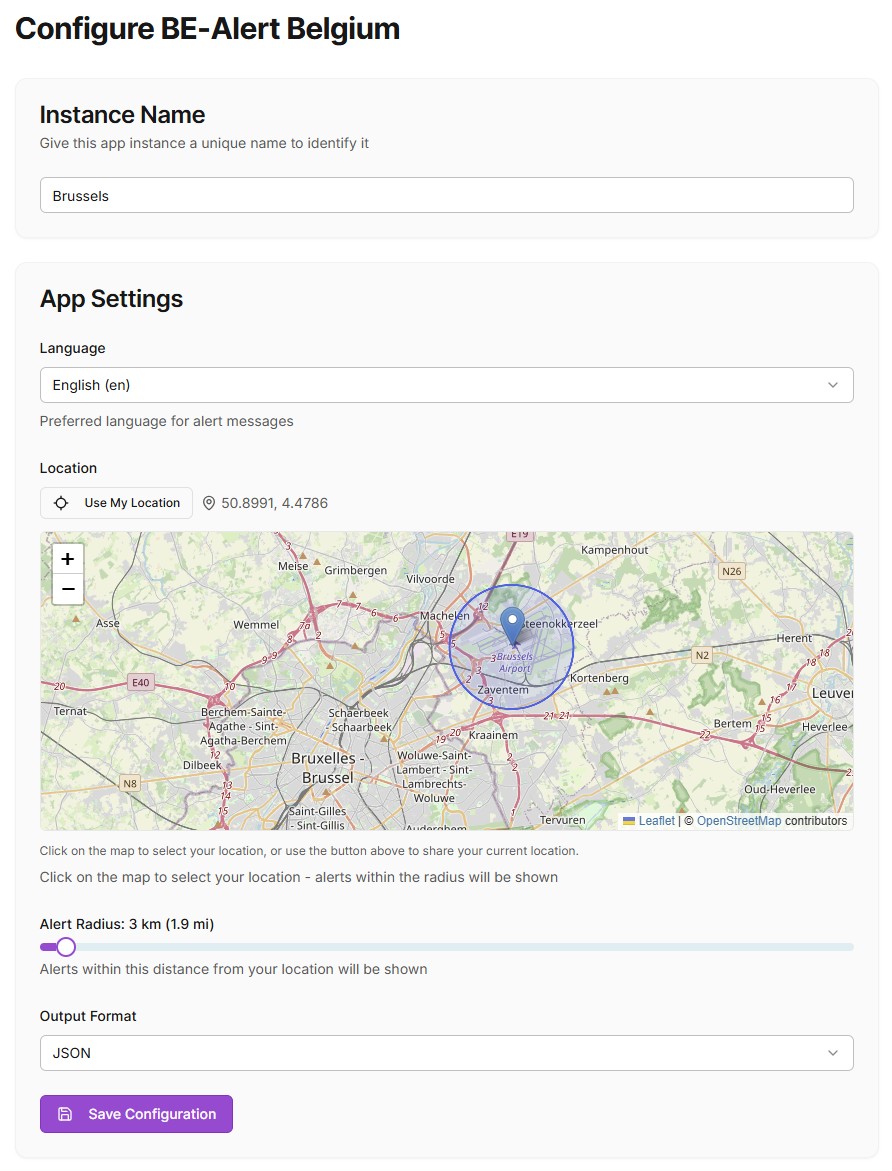
We designed the SignageTube BE-Alert App with simplicity and precision in mind. You don’t need to be an IT expert to set it up. The configuration process allows you to tailor the alerts to your exact needs, ensuring you only receive the information that is relevant to your location.
Here’s a step-by-step look at how you can configure the app:
1. Pinpoint Your Location
The first and most crucial step is defining your area of interest. Our intuitive interface includes an interactive map. You can simply click on the map to drop a pin on your facility’s exact geographical location. For even greater accuracy, you can use the “Use My Location” feature to automatically detect your current position. This ensures that the alerts are centered precisely where your operations are.
2. Set Your Alert Radius
Not every emergency in your province or city will directly impact your facility. To avoid unnecessary alarms, the app allows you to set a specific alert radius around your pinpointed location. You can define a range, for example, from 1 kilometer up to 50 kilometers. The app will then filter out any alerts that fall outside this designated circle, eliminating noise and ensuring that only relevant local warnings are processed.
3. Choose Your Language and Format
Communication is only effective if it’s understood. The app allows you to select your preferred language for the alert messages, ensuring clarity for your team. You can also configure the data output format, giving you technical flexibility for how the alert information is handled by your systems.
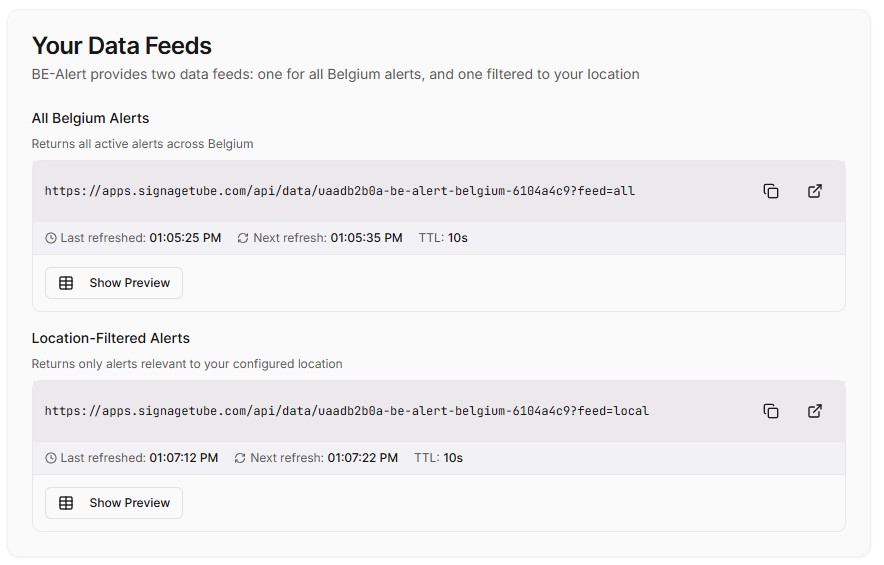
Once you save your configuration, the SignageTube App gets to work. It creates a unique data feed that continuously checks for BE-Alert messages that match your location and radius criteria.
From Data to Display: Real-Time Alerts with SignageTube Live
Having a filtered feed of alerts is only half the battle. The next step is getting those alerts in front of people’s eyes, and that’s where SignageTube Live comes in.
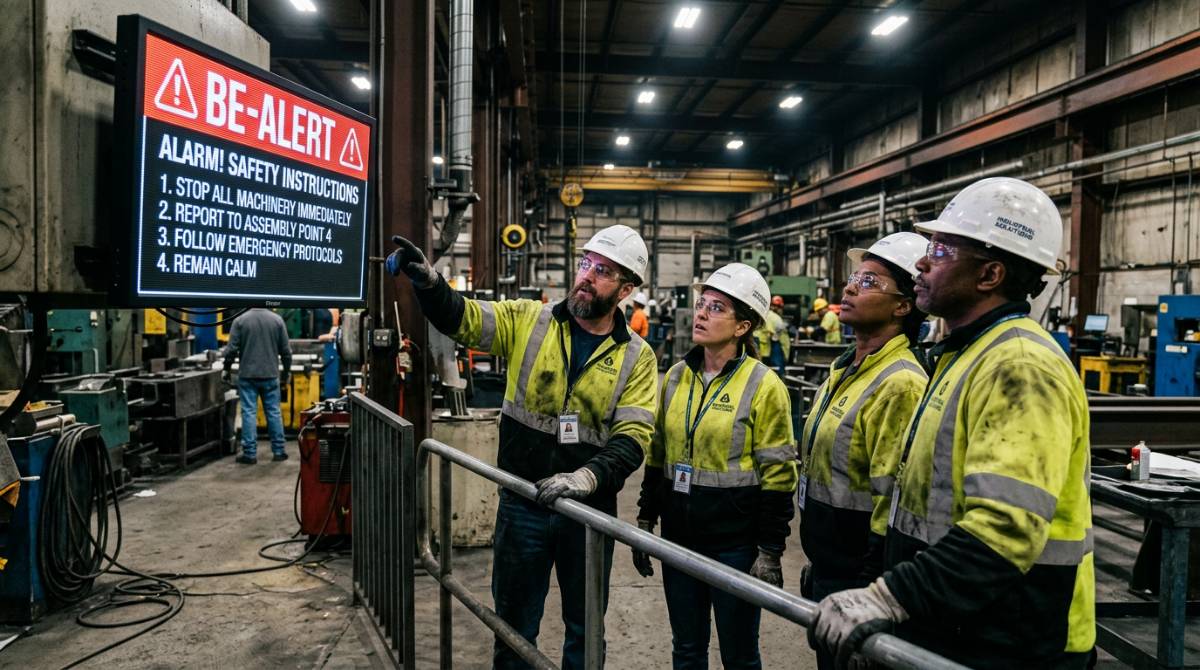
SignageTube Live is our solution for real-time digital signage, allowing you to harness the benefits of real-time digital signage for your business. It enables your screens to react instantly to external data, like the feed from our BE-Alert App. Display devices are the primary medium for presenting emergency content, and incorporating video can enhance the clarity and impact of alerts. When a relevant emergency alert is published, SignageTube Live can automatically interrupt the regularly scheduled content on your screens and display the critical warning.
This could be an instruction to “Evacuate Immediately,” a warning to “Shelter in Place,” or information about a nearby road closure that affects employee travel. The integration is seamless. Your digital signage transitions from a tool for marketing or internal communications to a life-saving device when it matters most. Transforming your digital signage experience with on-prem-based software improves customer engagement and internal communication by enabling centralized control of messaging. Digital signage is widely used in transportation hubs, retail stores, restaurants, corporate buildings, hotels, educational institutions, healthcare facilities, and public spaces.
Learn more about the power of dynamic content at https://signagetube.com/real-time-digital-signage/.
The Advantages of an Integrated Alert System
Integrating BE-Alert with SignageTube offers numerous benefits, especially for businesses like the factory that inspired this solution. Digital signage services provide enhanced engagement by enabling organizations to interact more effectively with both employees and customers, increasing participation and retention of important messages. With the integration of audience analytics and IoT sensors, organizations can personalize content delivery and measure the effectiveness of their communications in real time.
The demand for digital signage continues to rise as organizations move away from traditional printed signage, seeking more dynamic and flexible solutions. On-Prem-based digital signage platforms like SignageTube Live are particularly beneficial for organizations managing content across multiple locations with limited technical staff, allowing centralized control and streamlined updates.
However, it is important to address concerns related to privacy, safety, and environmental impact when implementing digital signage and audience measurement systems. By considering these factors, organizations can ensure responsible and effective deployment of their digital signage networks.
Key Advantages
- Unmatched Speed and Automation: In an emergency, every second counts. An automated system removes the risk of human delay. You don’t need someone to see a news report, check their phone, and then manually create and publish a warning to your screens. The moment BE-Alert issues a relevant warning, it appears on your displays automatically.
- Hyper-Localized and Relevant Information: General news alerts can be vague. The SignageTube BE-Alert App provides geographically-specific information. By setting your location and radius, you ensure the alerts are directly relevant to your facility and your people, preventing confusion and “alert fatigue.”
- Reaches Everyone On-Site: Relying on personal mobile phones for emergency alerts is a gamble. Not everyone will be subscribed, have their phone on, or even have a signal. Digital signage is a broadcast medium. It’s highly visible and capable of reaching everyone in a common area simultaneously, from full-time employees to temporary visitors.
- Clear, Consistent Messaging: The app pulls data directly from the official BE-Alert CAP feed. This means the information displayed on your screens is authoritative and consistent with the messaging being sent out by government agencies. This eliminates the risk of misinterpretation or spreading incorrect information during a crisis.
Warning System Maintenance: Ensuring Reliability and Readiness
Maintaining the reliability and readiness of your warning system is fundamental to delivering important emergency information when it matters most. Whether you’re relying on the Emergency Alert System (EAS), Wireless Emergency Alerts (WEAs), NOAA Weather Radio, or digital signage, regular maintenance ensures that your organization—and the public—can receive alerts quickly and accurately during any emergency situation.
Routine Checks and Testing
The National Weather Service, in partnership with FEMA’s national system and the Integrated Public Alert and Warning System (IPAWS), plays a pivotal role in keeping the national public warning system operational. These agencies, along with local authorities and alerting authorities, are responsible for ensuring that all components—from digital billboards to cell phones and satellite radio—are ready to deliver real-time content and critical alerts to a broad audience.
Routine checks are essential for digital signage networks, including digital billboards and screens across your facilities, especially when those networks depend on live data feeds and real-time dashboards. These checks verify that devices can receive alerts and display timely, accurate information during emergencies. For wireless providers, maintaining robust networks is crucial to handle the surge in traffic that can occur when WEAs and other emergency alerts are sent out, helping to prevent network congestion and ensuring that no alert is delayed or lost.
Maintaining Digital Signage Networks
A key feature of effective warning systems is the unique sound associated with EAS alerts and WEAs, which immediately captures attention and prompts action in the face of imminent threats. To maintain this effectiveness, local authorities must have access to user-friendly operating systems that allow them to send alerts quickly and efficiently, regardless of the emergency’s location or severity. This capability is vital for delivering essential information to customers, employees, and the public, whether through digital signage, mobile devices, or radio.
Regular Testing
Regular testing is a cornerstone of warning system maintenance. Local authorities and organizations should schedule routine tests of their emergency alert systems, including sending test alerts to mobile devices, verifying that digital signage displays the correct messages, and ensuring that the system can handle a high volume of alerts without issue. These proactive measures help identify and address any concerns before a real emergency arises, guaranteeing that your warning system is always ready to perform.
For businesses and organizations, maintaining your digital signage and alerting infrastructure is not just about compliance—it’s about customer engagement and public safety. A well-maintained system builds trust with your audience, demonstrating your commitment to their well-being and your ability to deliver important emergency information when it’s needed most. Investing in regular maintenance also protects your organization from potential financial losses and reputational damage that can result from failing to provide timely, accurate alerts during critical situations.
In summary, the ongoing maintenance of your warning system is essential for ensuring that you can deliver critical information to your audience, protect public safety, and uphold your organization’s reputation. By prioritizing regular checks, testing, and system updates, you ensure that your digital signage, mobile alerts, and radio communications are always ready to address any emergency—keeping your people, customers, and community safe.
Best Practices for Alert Systems
In today’s fast-paced world, having a reliable warning system is essential for public safety and business resilience. Whether facing severe weather, a national emergency, or a local incident, organizations must be prepared to deliver important emergency information quickly and effectively. The Emergency Alert System (EAS), Wireless Emergency Alerts (WEAs), and NOAA Weather Radio are foundational elements of the national public warning system, working in tandem with digital signage to ensure that timely alerts reach everyone, everywhere.
Best Practices for Emergency Alert Systems
- Integrate Multiple Alert Channels: Relying on a single method of communication can leave gaps in coverage. By combining digital signage, NOAA Weather Radio, EAS alerts, and wireless emergency alerts, you create a robust, multi-layered warning system. This ensures that critical messages are delivered even if one channel is disrupted.
- Prioritize Timely and Accurate Information: Speed is crucial during an emergency. Your system should be configured to receive alerts from trusted sources and display them without delay. Automated solutions, like those offered by SignageTube, help ensure that important emergency information is broadcast to your audience the moment it’s available.
- Ensure Clarity and Consistency: Emergency alerts must be clear, concise, and easy to understand. Use standardized language and formats, as recommended by national and local authorities, to avoid confusion. Digital signage can reinforce these messages visually, making them accessible to everyone on-site.
- Regularly Test and Update Your System: Routine testing of your warning system—including digital signage, radio, and mobile alerts—helps identify potential issues before a real emergency occurs. Stay up to date with the latest protocols from the national public warning system and local authorities to maintain readiness.
- Educate Your Team: Make sure your staff knows how to respond when an emergency alert is issued. Provide training on recognizing alerts from various sources, including digital signage and NOAA Weather Radio, and establish clear procedures for different types of emergencies.
Educating Your Team
By following these best practices, organizations can strengthen their ability to deliver timely, essential warnings and protect their people during any emergency. Integrating digital signage with established systems like the Emergency Alert System and NOAA Weather Radio ensures that your business is prepared to respond quickly and effectively, no matter what challenges arise.
BE-Alert FAQ: What Businesses and Individuals Need to Know
What is BE-Alert?
BE-Alert is a government-operated emergency notification system in Belgium that sends instant, location-specific warnings to the public.
How do I register for BE-Alert?
Registration is free and can be done online. You can register multiple addresses (such as home, work, or school) to receive alerts for those locations.
How are BE-Alert notifications delivered?
Notifications are sent via SMS, email, or voice call. BE-Alert messages may also appear on digital information boards along public roads.
What types of emergencies does BE-Alert cover?
BE-Alert covers a wide range of emergencies, including fires, floods, health crises, power outages, and more.
Is BE-Alert available everywhere in Belgium?
BE-Alert covers 93% of Belgian municipalities and continues to expand.
What languages are supported?
BE-Alert can deliver messages in multiple languages, making it accessible to a broad audience.
Is there a cost to register or receive messages?
No, both registration and receipt of BE-Alert messages are free of charge.
How does BE-Alert protect my privacy?
BE-Alert does not track individual locations, even though it uses geographic data to target alerts. Your privacy is protected.
How can I recognize official BE-Alert messages?
Official BE-Alert messages always start with ‘BE-Alert’ and originate from the number 1789 or 0477 77 77 55.
When does BE-Alert operate?
BE-Alert operates 24/7, ensuring you can be warned at any time of day.
What should I do when I receive a BE-Alert?
Follow the direct, official instructions provided in the message to stay safe. BE-Alert messages are designed to reduce panic and provide clear guidance during a crisis.
Protect Your People, Protect Your Business
For the factory manager and for any business leader, ensuring employee safety is not just a regulatory requirement; it’s a moral one. Companies are increasingly adopting digital signage solutions to better serve their customers and enhance engagement, moving away from traditional printed signage and embracing hybrid approaches. By leveraging the SignageTube BE-Alert App, you can add a powerful, automated, and reliable layer to your organization’s emergency preparedness strategy.
Modern digital signage platforms support a variety of operating systems, ensuring compatibility and flexibility across different signage devices, and the future of implementing real-time information on digital displays continues to expand what’s possible. Many resources, such as digital signage encyclopedias, are available for free online to help organizations learn about best practices and technology trends. Responsible management of digital signage systems is essential, including features like PowerPoint-based design, professional templates, remote monitoring, and proof of play logging to ensure content is displayed as intended.
You can transform your existing digital signage network from a passive communication tool into an active shield, providing clear guidance and critical information at a moment’s notice. It’s a modern solution to a timeless challenge: keeping your people safe from harm.
Take the first step toward a safer facility today. Explore the BE-Alert App and our other real-time solutions to see how you can build a more resilient and responsive organization.