
Retail store digital signage is transforming the way retailers, store managers, and marketing professionals engage customers and drive sales in 2026. This comprehensive guide is designed for anyone responsible for in-store marketing, operations, or customer experience in brick-and-mortar retail environments. Here, you’ll discover why digital signage matters more than ever: it’s not just about replacing posters with screens, but about creating dynamic, data-driven, and personalized experiences that boost revenue, streamline operations, and keep your brand competitive. Expect actionable insights, real-world examples, and a step-by-step blueprint for planning, deploying, and optimizing digital signage in your retail stores.
Key Takeaways
- Retail store digital signage in 2026 drives measurable sales lifts of 24-38% on featured products, creates new revenue streams through retail media networks, and transforms the in-store experience with dynamic, personalized content that responds to time, weather, and inventory in real time.
- Well-placed in-store displays can increase revenue by up to 13.37% without adding products or using more space.
- This guide covers both hardware considerations (LED, LCD, video walls, window-facing displays) and software essentials (content management, data integration, retail media networks) for brick-and-mortar stores of all sizes.
- You’ll find practical examples from supermarkets, fashion retailers, QSR chains, and pharmacies, with concrete numbers on conversion rates, revenue per screen, and foot traffic increases that demonstrate real-world ROI.
- By the end, you’ll understand how to plan, deploy, measure, and monetize a complete in-store digital signage strategy that turns screens into profit centers.
- A closing FAQ addresses common questions about implementation timelines, budgets, content refresh cadence, and avoiding shopper fatigue.
Reinventing Retail Store Digital Signage
Retail digital signage delivers real-to-life, eye-catching picture quality and a redefined in-store experience.
Evolution from Static to Dynamic
The digital signage you might remember from 2018—basic menu boards cycling through static images, or a single screen playing the same promotional loop for months—has evolved into something far more sophisticated. Today’s retail digital signage operates as an AI-ready, revenue-generating platform that combines real-time data, dynamic content, and precise targeting to influence purchase decisions at the exact moment they’re being made.
Many retailers struggle to adapt brick-and-mortar stores to evolving shopper expectations, making advanced store retail digital signage solutions essential for staying competitive.
Personalization and Targeting
Modern in-store digital signage gets shoppers to stop, browse, and buy by combining motion, color psychology, and hyper-localized offers at critical points in the shopping journey. When a customer walks past an endcap, the screen doesn’t just show a generic promotion—it displays content targeted by real-time data to current inventory levels, time of day, or even local weather conditions. This shift from passive display to active selling tool represents a fundamental change in how retailers think about their physical store environments.
Visual Merchandising Impact
High-brightness 4K and LED displays now deliver picture quality that makes products look more appealing than they ever could on static print materials. A fashion retailer can showcase fabric textures and movement in ways that flat photography never captured. Electronics stores can demonstrate product interfaces at native resolution. Cosmetics brands can display color accuracy that matches what customers see in mirrors.
The visual fidelity gap between digital and print has widened to the point where well-designed store digital signage doubles as visual merchandising, wayfinding, and promotional delivery all at once.
Real-World Applications
Consider how this plays out across different retail environments:
- A grocery store uses endcap screens to promote time-sensitive deals on produce, with content that automatically updates based on what’s overstocked in the back room.
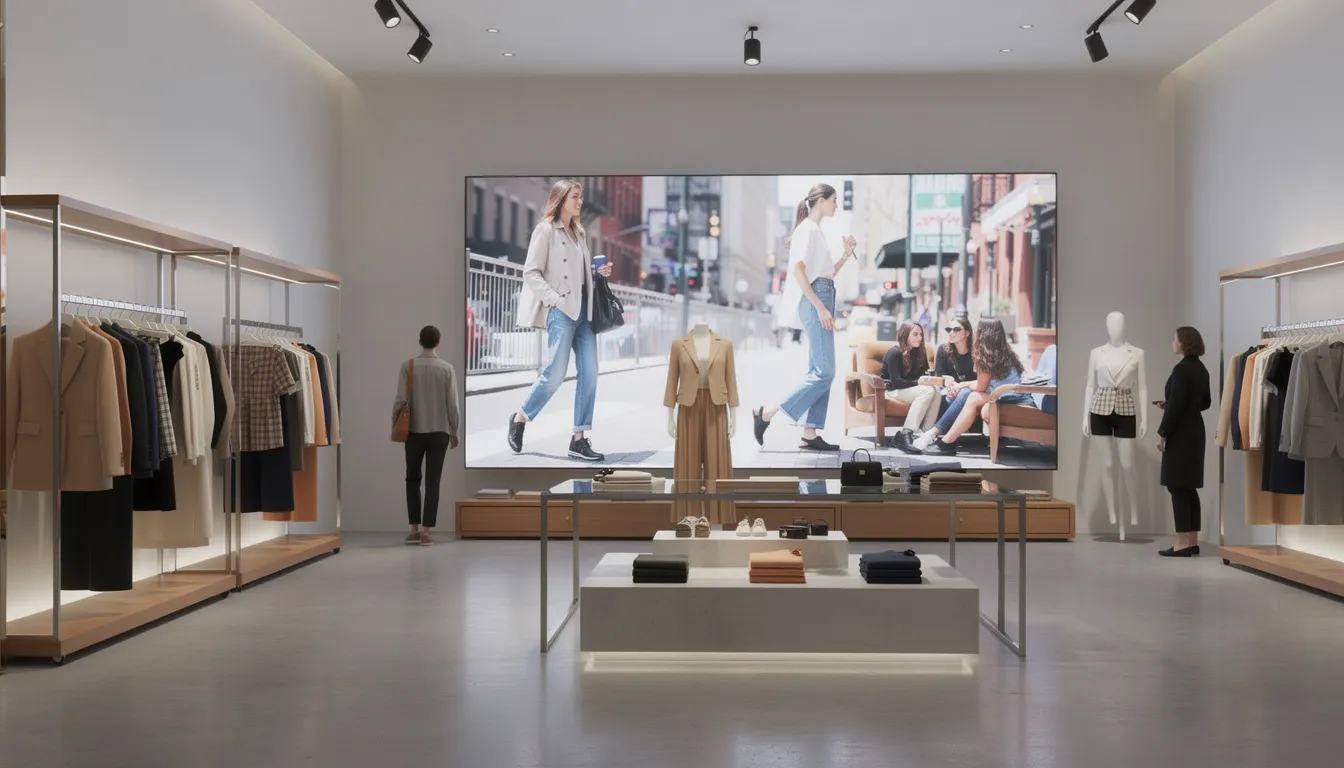
- A fashion boutique runs lifestyle lookbooks on video walls near the entrance, creating an immersive branded experience before shoppers even touch a rack.
- A pharmacy displays health tips and seasonal wellness reminders that build trust while subtly promoting relevant products.
Each format serves a different purpose, but all share the common thread of turning passive retail space into active selling surface.
“Retailers using targeted digital signage content see up to 24-38% sales lifts on featured products compared to static signage.”
This isn’t theoretical. The numbers reflect what happens when you put the right message in front of the right customer at the right time—a principle that digital channels have exploited for years, now finally making its way to physical retail locations.
Window-Facing & Outdoor Retail Signage
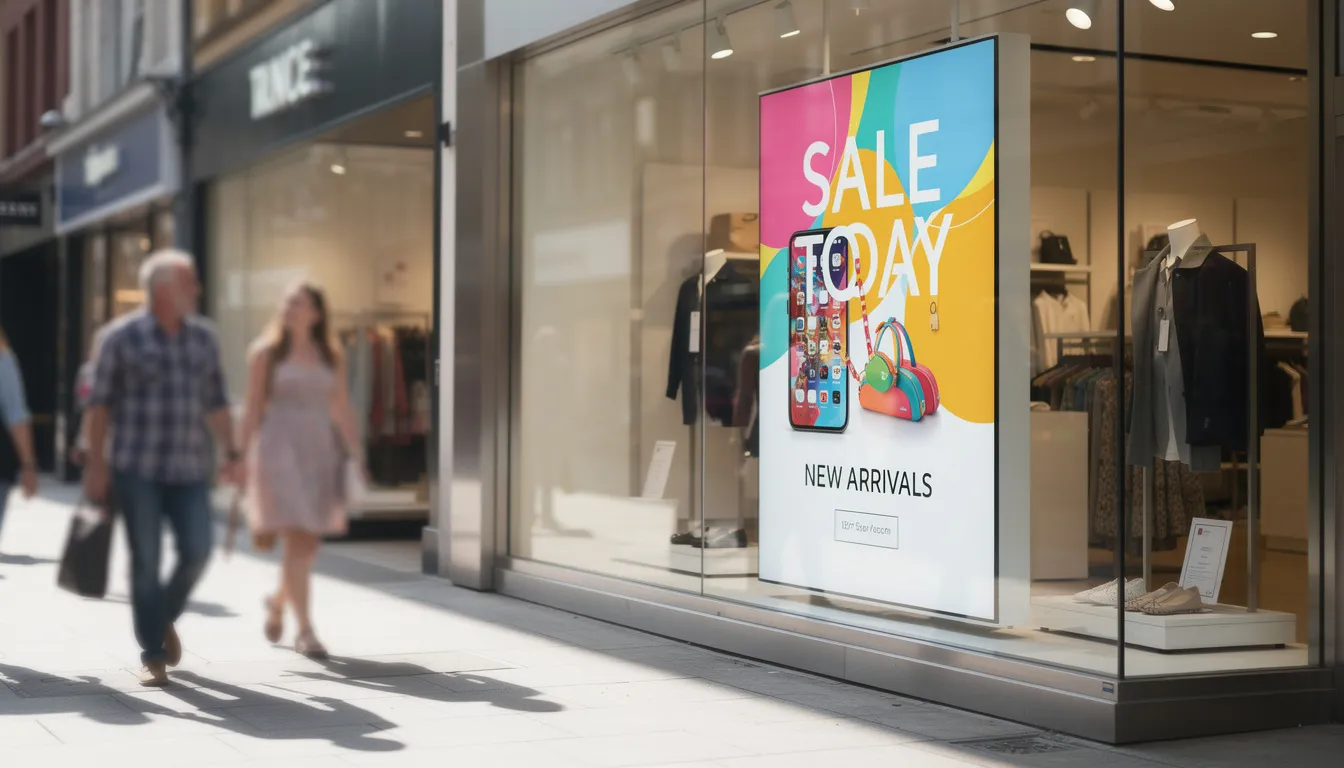
Window-facing digital signage acts as a 24/7 storefront salesperson, converting passersby into store visitors without requiring a single staff member to stand outside. In high-traffic shopping malls and busy retail streets, the window is often your only chance to capture attention before someone walks past. Static posters compete with dozens of other visual stimuli. Motion wins.
Technical Considerations
The technical challenge here involves brightness. Standard indoor displays wash out completely when placed behind glass facing direct sunlight. High-brightness displays rated at 2,500-4,000+ nits overcome this limitation, maintaining visibility even on bright afternoons when sunlight streams directly at the storefront. Without adequate brightness, your investment becomes invisible exactly when foot traffic peaks.
Dual-Sided and Outdoor Displays
Dual-sided displays offer a clever solution for retailers who want maximum value from window real estate. The outward-facing screen shows flash sales, new arrivals, or time-limited offers to draw people inside. The inward-facing screen delivers different messaging—perhaps wayfinding information or loyalty program promotions—to customers who’ve already entered.
Outdoor-rated units extend the possibilities beyond the storefront window. IP-rated, weather-resistant screens handle sidewalk installations, drive-thru lanes, and forecourt positions. These displays are engineered to endure rain, extreme heat, and freezing temperatures while maintaining image quality and operational reliability.
Best Practices for Window Displays
A high-impact window display should feature:
- Bold motion graphics that catch peripheral vision
- Large fonts readable from across the street
- Minimal text that communicates a single clear message
- Dayparted offers that change based on morning commute traffic versus evening shopping patterns
The goal isn’t to cram information onto the screen—it’s to create a visual moment compelling enough to make someone change their walking path.
Immersive Spatial Signage & In-Store Experience
Spatial signage moves beyond single screens into multi-display configurations that reshape how a retail environment feels.
Brand Storytelling with Spatial Signage
Think ceiling-mounted LED strips that guide customers through departments, wrap-around video walls that envelop shoppers in brand storytelling, or floor-to-ceiling LCD installations that transform a blank wall into a dynamic canvas. This category of signage isn’t about delivering promotional messages—it’s about creating atmosphere.
Customer Interaction Examples
Shoppers interact with immersive digital signage in various ways, from engaging with interactive advertising screens and touch-enabled displays to responding to motion sensors. These interactive displays further enhance the customer experience by making the environment more engaging and memorable.
Ambient Content Best Practices
The key to successful ambient content lies in restraint. Subtle product storytelling—showing how items are made, where materials come from, or how products fit into real life—works better than aggressive promotional loops. Ambient animations that flow naturally across multiple screens create visual interest without demanding attention. When done well, customers may not consciously notice the signage, but they’ll feel more comfortable spending time in the space.
Consider a flagship fashion store using an LED archway at its entrance. As customers walk through, color harmonies shift to complement the current collection—warm earth tones for fall, bright pastels for spring. Or picture a supermarket’s fresh food zone, where overhead LED ribbons display imagery of farms, orchards, and fishing boats, subtly reinforcing messages about freshness and origin while customers select produce.
These installations benefit from careful attention to motion speed, color temperature, and even audio considerations. The content should match the brand’s personality and the customer’s expected emotional state in that space.
Display Technologies for Retail: 4K, LCD Video Walls, and Direct View LED
Choosing the right display technology affects clarity, reliability, and total cost of ownership across a 3-5 year retail rollout. Each technology excels in specific applications, and mismatches create problems ranging from poor visibility to unnecessary expense.
4K UHD Single Displays
4K UHD single displays serve as the workhorse of in-store signage. They handle menu boards in QSR locations, shelf-level screens in grocery aisles, endcap promotional displays, and fitting room mirrors in fashion retail. The detail and color accuracy of 4K resolution matters most in applications where customers view screens from close range and where product imagery needs to look true-to-life.
LCD Video Walls
LCD video walls work best for large, flat surfaces where multiple panels tile together into a single canvas. Atriums, feature walls, and promotional zones in shopping malls commonly use this approach. Modern video walls feature near-seamless bezels—the frames between panels have shrunk to the point where viewers perceive a continuous image.
Direct View LED (dvLED)
Direct view LED (dvLED) represents the premium option for truly seamless large formats and creative shapes. Unlike LCD walls, dvLED has no bezels whatsoever—the image flows continuously across any size or configuration. Retailers use dvLED for curved installations, columns wrapped in moving content, and storefront windows where bezel lines would break the visual effect.
Matching Technology to Application
- LED pixel pitch determines how close viewers can stand before they see individual pixels.
- Content type influences decisions: fast-moving video requires different refresh specifications than static pricing information.
- A hybrid approach—using dvLED in storefront windows and 4K LCDs throughout the interior—can optimize both visibility and budget.
AI Powered Digital Signage Solutions
AI-powered digital signage is transforming the retail landscape by delivering highly personalized and immersive experiences that drive measurable results.
Benefits of AI Integration
- Advanced machine learning algorithms analyze customer behavior, preferences, and real-time data to deliver targeted promotions and content.
- Retailers can automate the process of updating displays with real-time dynamic content, ensuring that promotions, product information, and branded content are always relevant and up to date.
- AI-powered digital signage helps retailers drive sales and unlock new revenue streams, including opportunities for retail media and targeted ads from brand partners.
For retailers looking to stay ahead, AI-powered digital signage is a strategic investment that creates new revenue, optimizes operations, and ensures every customer interaction is meaningful and memorable.
Use Cases: How Leading Retailers Deploy Digital Signage
Digital signage has become standard across grocery, fashion, QSR, electronics, home improvement, and pharmacy verticals. Each sector adapts the technology to its specific customer journey and product categories.
Fashion and Lifestyle Retailers
Fashion and lifestyle retailers lead adoption with approximately 28.9% of market share. A typical implementation includes:
- Window displays that rotate seasonal collections
- Fitting room screens that show styling inspiration and complementary products
- Central video walls that create immersive brand moments
Some retailers incorporate user-generated content—social media posts from customers wearing their products—to build community and authenticity. Seasonal drops get dedicated screen time, creating urgency and exclusivity around new arrivals.
Grocery and Supermarket Implementations
Grocery and supermarket implementations focus on driving basket size through strategic screen placement:
- Aisle screens promote products in adjacent categories—pasta near screens showing sauce promotions.
- Endcap digital displays feature time-sensitive real-time deals that create urgency.
- Checkout screens suggest last-minute additions while customers wait.
- Recipe videos near ingredient sections inspire shoppers to purchase multiple items for a meal they hadn’t planned.
Grocers using this approach consistently report measurable basket-size increases, with some achieving up to 32% overall sales growth.
Electronics Retailers
Electronics retailers face a unique challenge: their products are often too complex for quick understanding. Digital signage addresses this with:
- Explainer loops that break down features into digestible segments
- Interactive kiosks for specification comparisons
- Smart home device demonstrations in simulated room environments
One regional electronics chain coordinated indoor educational content with outdoor promotional signage during a back-to-school campaign, resulting in double-digit traffic and conversion uplifts compared to the previous year.
From Signage to Retail Media Network
Screens inside stores don’t just promote your own products—they can generate entirely new revenue streams by selling advertising space to brands and suppliers. This evolution transforms digital signage from a cost center into a profit center through what the industry calls a retail media network.
How Retail Media Networks Work
- Retailers control screen placements and context, ensuring ads appear in relevant locations near point of sale moments.
- Brands pay for exposure to shoppers who are already in purchasing mode.
- The content mix balances paid advertising with genuinely helpful information so screens remain valuable to customers rather than pure ad platforms.
Data and Privacy
First-party data makes retail media networks particularly valuable to advertisers. Transaction data from point of sale systems, behavioral insights from loyalty programs, and traffic patterns from in-store analytics enable targeting and reporting capabilities that third-party advertising platforms can’t match.
Privacy-conscious practices remain essential. Retailers must handle customer data responsibly, focusing on aggregate patterns rather than individual tracking, and ensuring transparency about what information they collect and how it’s used.
Content Strategy: Delivering the Right Message at the Right Time
Content quality and relevance matter more than screen count. A retailer with twenty poorly-programmed screens will underperform a competitor with four screens running strategic, timely content.
Dynamic Content Adaptation
Modern real-time digital signage software can adjust messaging based on:
- Time of day
- Day of week
- Weather conditions
- Current inventory levels
- Local events
A real-time digital signage content strategy should be responsive to real-time customer needs, tailoring messaging and promotions based on customer-specific data and behaviors to enhance the shopping experience.
Customer-First Messaging
Screens should deliver:
- Clear pricing information
- Inventory-aware promotions that don’t advertise out-of-stock items
- Local community messages that feel relevant rather than generic
- Service announcements that help shoppers navigate the store
Paid media from brand partners fits into this mix, but shouldn’t dominate screen time to the point where customers tune out.
Creative Design Guidelines
- Large fonts remain readable from typical aisle distances—usually 3-6 feet for shelf screens, 10-20 feet for wall-mounted displays.
- High contrast ensures visibility under varied store lighting conditions.
- Each frame should communicate a single key message rather than cramming multiple offers together.
- Loop lengths typically range from 15-45 seconds.
Do: Use AI tools to personalize and localize content at scale, automatically adjusting promotions based on regional preferences or store-specific inventory.
Don’t: Run the same generic national promotional loop across all retail locations regardless of local relevance or inventory reality.
Content Mix Guidelines
A reasonable starting point allocates approximately:
- 40% of screen time to promotional content
- The remainder split between brand storytelling, utility information (wayfinding, service hours, loyalty programs), and entertainment content
These ratios should adjust based on screen location—checkout screens might skew more promotional, while entrance screens balance welcome messaging with featured products.
Placement, Layout, and Shopper Journey Mapping
Strategic screen placement along the customer journey boosts revenue without requiring additional shelf space. The goal isn’t maximum screen count—it’s maximum impact per screen, positioned where customers are most receptive to messaging.
Key Placement Zones
- Entrance screens: Capture arriving shoppers at their most open-minded moment. Ideal for new products, seasonal features, and overall brand messaging.
- Decision-point screens: Near product comparison zones, these drive measurable purchase uplift by providing information at the moment of choice.
- Checkout screens: Catch customers during otherwise empty waiting time for impulse additions, loyalty program enrollment, and upcoming events promotion.
Store Layout Examples
- In a typical 1,500-2,000 m² supermarket, screens cluster at fresh food zones, endcaps, and checkout lanes.
- A smaller 300-500 m² fashion store might position screens at window-facing locations, near or inside fitting rooms, and on a central wall visible from most of the floor.
Best Practices
- Line-of-sight matters more than screen quantity.
- Displays mounted too high go unnoticed.
- Accessibility considerations—ensuring screens are viewable from various heights and don’t create obstacles—affect both compliance and customer experience.
A small footprint store with 2-4 well-placed screens will outperform a larger space with a dozen poorly positioned displays.
Digital Signage and Accessibility
Digital signage plays a pivotal role in making retail environments more accessible and inclusive for all customers.
Accessibility Features
- Audio descriptions, closed captions, and high-contrast display modes ensure that shoppers with visual or hearing impairments can easily access important information.
- Interactive maps and directional cues help all customers, including those with mobility challenges, find products, services, and amenities efficiently.
- Digital signage can also highlight wheelchair-accessible routes, elevators, and accessible restrooms.
By prioritizing accessibility in their digital signage strategy, retailers not only comply with legal requirements but also demonstrate a genuine commitment to inclusivity.
Digital Signage and Sustainability
Embracing digital signage is a smart move for retailers committed to sustainability and environmental responsibility. Digital displays eliminate printing costs, allowing for instant, centralized, real-time updates across multiple locations, and reduce paper waste by eliminating recurring printing and shipping expenses.
Environmental Benefits
- By replacing traditional printed materials with dynamic digital screens, retailers significantly reduce paper waste and the environmental impact associated with frequent poster and flyer updates.
- Energy-efficient digital signage solutions further lower energy consumption, helping retailers minimize their carbon footprint while maintaining vibrant, engaging displays.
Promoting Sustainability
- Digital signage offers a platform to promote sustainable practices and eco-friendly products directly to customers.
- Retailers can use screens to educate shoppers about recycling programs, green product lines, and the importance of environmental stewardship.
Additionally, digital signage streamlines supply chain and logistics operations by enabling real-time updates and reducing the need for unnecessary transportation and packaging.
By integrating sustainable digital signage practices, retailers enhance their brand reputation, appeal to environmentally conscious customers, and contribute to a greener retail industry.
Digital Signage and Security
Digital signage is an essential tool for enhancing security and safety in retail environments.
Security Applications
- Displaying real-time alerts, security messages, and warnings to proactively deter shoplifting, vandalism, and other security threats.
- In the event of an emergency, digital signage provides clear, immediate instructions for evacuation or shelter-in-place procedures.
Integration with Security Systems
- Integration with security systems such as CCTV cameras and access control further strengthens the store’s security posture.
- Digital signage can display live feeds, restricted area notifications, or reminders about store policies.
By making security a core part of their digital signage strategy, retailers protect their customers, employees, and assets.
Digital Signage and Employee Engagement
Digital signage isn’t just for customers—it’s a powerful tool for boosting employee engagement and communication within retail environments.
Internal Communication
- Use digital screens to share important announcements, training materials, and company news.
- Recognize employee achievements and milestones to enhance morale and motivation.
- Provide easy access to essential resources, such as employee handbooks, benefits information, and shift schedules.
By leveraging digital signage to keep employees connected and engaged, retailers can improve productivity, reduce turnover, and create a more positive, collaborative workplace.
Measuring Performance and Optimizing ROI
Digital signage must be measured like any other performance channel, not treated as a sunk decor cost. Without measurement, you’re decorating. With measurement, you’re optimizing a revenue driver.
Key Metrics and KPIs
- Sales lift per promoted SKU: Typically 24-38% for well-executed campaigns
- Conversion rate changes: In screen-adjacent areas
- Basket size increases: Averaging 29.5% in documented cases
- Dwell time near screens: Motion graphics can increase this by 30%
- Content play/loop completion rates: Indicate engagement
Data Collection Methods
- POS integrations to correlate promotional screen content with actual sales data
- Traffic analytics to track how many customers pass screens versus how many pause
- Dwell sensors to measure how long customers remain in screen view
- QR codes and short URLs on screens for direct response tracking
- Loyalty app redemptions to tie promotions to individual customer behavior
- A/B testing between stores or time periods to isolate the impact of specific content changes
Optimization Process
- Adjust creative elements based on engagement data
- Shift scheduling based on traffic patterns
- Reposition screens based on heat maps
- Pair quantitative metrics with qualitative feedback from staff and shoppers
FAQs about Retail Store Digital Signage
How much does a retail digital signage rollout typically cost per store?
Costs vary significantly based on store size and complexity. A small boutique with 2-3 screens might invest $5,000-15,000 initially per store, covering hardware, installation, software licenses, and initial content creation. A supermarket with 15-30 screens across multiple zones typically requires $50,000-150,000 per location. Annual ongoing costs—software licenses, content refresh, maintenance—add $1,000-5,000 per store. These costs can be offset by documented sales uplift (24-38% on featured products is common) and retail media network revenue from brand advertisers purchasing screen time.
How quickly can retailers see measurable results from digital signage?
Initial qualitative feedback—staff observations, customer comments—emerges within the first few weeks after deployment. Measurable sales or engagement changes typically appear within one or two campaign cycles, roughly 4-8 weeks. Strong pilots with clear KPIs and controlled testing conditions can demonstrate payback periods for many categories within the first year. Promotional content shows faster results than brand-building content, which delivers value over longer timeframes.
Do I need new content all the time to keep screens effective?
You don’t need daily new content, but you do need a structured refresh cadence. Weekly promotional updates keep offers current and prevent customer fatigue. Monthly brand storytelling refreshes maintain engagement. Seasonal content updates (4-6 times per year) align with major retail calendar moments. Use modular templates that allow quick updates of pricing, product images, and copy without rebuilding entire campaigns. The goal is relevance, not novelty for its own sake.
What if my stores have limited bandwidth or unreliable internet?
Modern digital signage players cache content locally, meaning screens continue running their scheduled loops even when network connections drop temporarily. Content downloads can be scheduled during off-peak hours—overnight, for example—to minimize bandwidth strain during business operations. Offline-capable retail digital signage software ensures that connectivity issues don’t create blank screens or error messages in front of customers. When selecting systems, prioritize solutions designed for distributed retail environments with variable connectivity.
How can I ensure digital signage doesn’t overwhelm or annoy shoppers?
Keep audio levels low or use muted content in browsing zones—save sound for designated areas where customers expect it. Limit flashing effects and rapid transitions that create visual noise. Maintain loop lengths of 15-45 seconds to avoid obvious repetition during typical shopping dwell times. Test content with store staff and small shopper groups before broad deployment, adjusting brightness, motion speed, and frequency based on real feedback. Remember that 40% of consumers sometimes ignore digital signage, usually because content feels irrelevant or intrusive. Content that helps shoppers—providing useful information, genuine deals, or entertainment value—earns attention rather than demanding it.